
Artificial Intelligence
Executive Summary
The Imperative of Connectivity: Powering AI’s promise in Education
The rapid evolution of Artificial Intelligence (AI) presents a transformative opportunity for education systems worldwide. However, the effective integration and widespread adoption of AI in educational environments are fundamentally contingent upon robust digital connectivity. The global reality is that AI adoption is advancing faster than the foundational infrastructure. In this article, we outline a practical pathway toward systemic AI adoption in education, grounded in real- world connectivity testing.
Global projections from Nokia forecast a substantial surge in AI-induced network traffic, anticipating a growth at 23% CAGR from 2024-2034, reaching 921EBs per month [1]. This growing momentum is visible in Saudi Arabia, where 21.5% of internet users actively utilize AI tools [2].
Furthermore, national statistics indicate that 27.6% of establishments across sectors use AI technologies, including the education sector, demonstrating a particularly high adoption rate of 42.1% in AI activities [3]. These figures underscore a strong appetite for AI-driven innovation in education.
Furthermore, a survey conducted in 2025 by the C4IR Saudi Arabia in collaboration with the Ministry of Education targeted national teachers, showing that more than 22k teachers reported limitations in their ability to effectively use AI tools in classroom settings [4]. Without adequate connectivity, premature adoption of AI in education risks being undermined by systemic bottlenecks.
Bridging the Digital Divide: Lessons for Crisis and Future Imperatives
The critical role of connectivity was starkly illuminated during the COVID-19 pandemic, which exposed major gaps in the global digital infrastructure. UNICEF reported that 31% of school‑age learners could not access remote learning due to limited internet access and a lack of devices [5]. In addition, it revealed a clear urban-rural divide, with only 25% of rural children having home internet compared to over 40% in urban areas [6].
Saudi Arabia experienced similar challenges, particularly in remote regions where weak connectivity hindered students’ access to digital learning. In response, the Ministry of Education implemented rapid interventions to reach learners without devices or with unstable internet access. These efforts have accelerated national investments in digital infrastructure, enabled the Kingdom to strengthen its connectivity landscape, and helped it leapfrog toward more resilient, AI-ready infrastructure.As AI becomes increasingly central to education, strengthening connectivity across all regions becomes an essential prerequisite. It ensures equitable access to AI-enabled learning, prevents educational disparities, and fosters an inclusive future for every student and teacher.
A Tiered Framework for AI Connectivity
Connectivity is a critical enabler that influences equal access in AI-driven learning environments. However, a knowledge gap persists regarding whether the current connectivity landscape is sufficiently ready to support effective AI integration in education. To facilitate a phased adoption of AI, it is essential to establish a network requirements baseline. Based on the National eLearning Center (NeLC) AI competency report [7] AI applications in educational settings, as shown in Table 1, can be categorized into three categories: Basic applications for text generation, Intermediate applications including image generation, and Advanced applications including large-scale analysis and databases.
Table 1: Educational use cases adopting AI (non-exhaustive)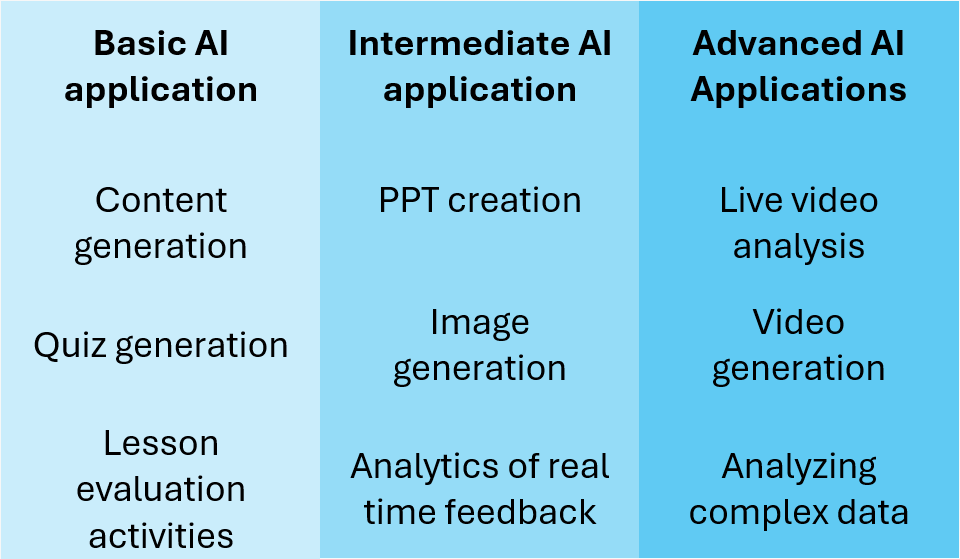
These categories can accommodate varying levels of connectivity. AI use case levels are optimized to match existing connectivity tiers and to utilize existing connectivity infrastructure. Matching use cases with connectivity tiers can help users identify different stages of adoption.
In collaboration with Noon Academy, a leading EdTech platform in the Middle East that teaches through fully AI‑enabled classrooms, we evaluated the network requirements for selected AI use cases in a real classroom setting. The test included assessing the network performance from students’ school tablets in a live classroom during an AI-focused lesson [8]. The test covered basic and intermediate AI usage.
During the test, the classroom internet was connected through fiber optics, which is considered a highly reliable connection. Real-time throughput was continuously monitored, revealing clear limitations in both download and upload performance.
Findings showed that at a throughput of 115 Mbps per classroom, basic AI applications for text generation consumed approximately 2 MBs, equating to approximately 50 MBs for a typical classroom of 25 users. This result is considered particularly good, from a network utilization standpoint, as the classroom only used about 50% of network capacity ensuring smooth application on multiple devices.
However, when usage progressed to intermediate AI applications, performance challenges became more evident. For example, generating five images demanded significantly higher throughput and resulted in noticeable delays up to 9 min due to network congestion. This implies that image-heavy AI use, such as generating presentations in classrooms, is likely to experience performance issues over typical connections unless the school upgrades its connectivity tier.
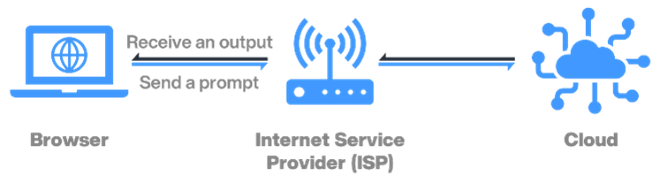
These observations highlight the sensitivity of AI driven applications to network throughput, particularly across the critical path between the user’s browser and the Internet Service Provider (ISP) as shown in Figure 1. The bottleneck of network congestion depends on the internet provider and the chosen internet package.
Following classroom testing, we have aligned AI use cases with conventional connectivity packages, allowing users to identify their level of AI integration. They can target AI applications compatible with their existing connectivity environment. This awareness of network requirements could enable informed planning and help maintain reliable learning experience.
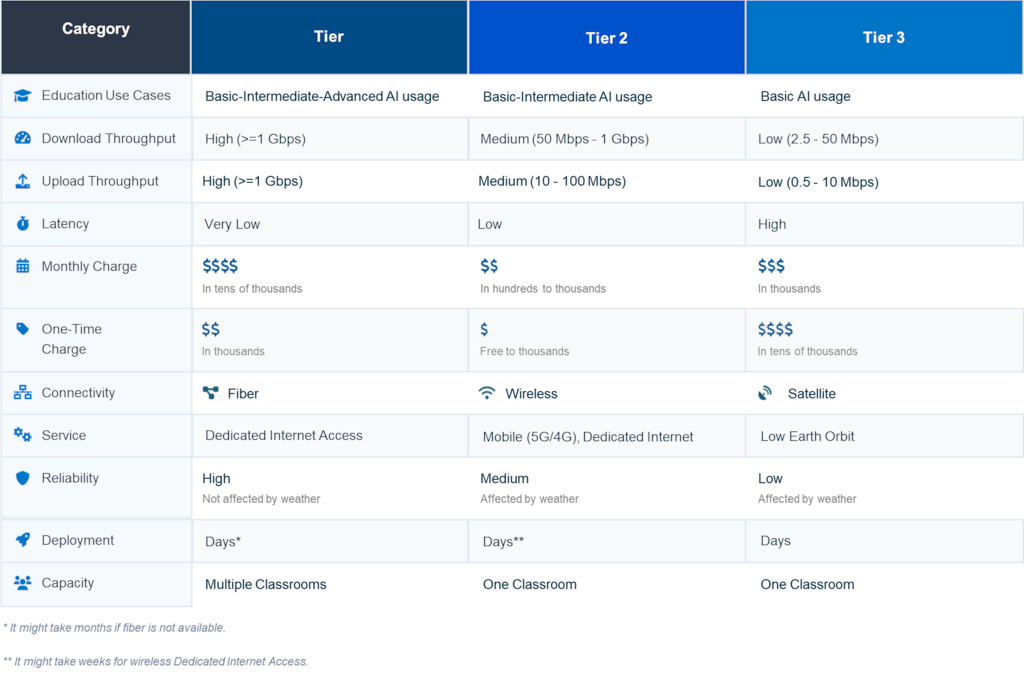
As summarized in Table 2, there are three Tiers of connectivity, each tier would be best fit to specific use cases and infrastructure features. For example, an educator can use this table to decide which AI application category to use in the classroom.
Table 2: Connectivity table to compare three connectivity tiers: Fiber, Wireless, and Satellite across key technical and operational categories such as download and upload throughputs, latency, reliability, deployment time, cost, and capacity.
Conclusion
These findings demonstrate a relationship between AI use case categories and connectivity tiers. Basic AI applications can operate effectively on conventional internet solutions; however Intermediate and Advanced use cases require higher throughput, lower latency, and more stable network performance from Tier 1 networks.
AI adoption would be optimally supported by Dedicated Internet Access (DIA) through wireless or fiber connectivity. DIA service is widely available, provides low latency and high throughput, and offers stable performance better than conventional solutions, enabling AI applications to operate smoothly in classrooms without disruptions. This is true, especially since internet penetration in Saudi Arabia has reached 99% [9].
As educational institutions progress along the AI adoption curve, a phased connectivity approach can be more practical to ensure minimal disruption when introducing AI tools.
[1] Global network traffic 2025 – Nokia
[2] Saudi Internet Report 2024 – CST
[3] Establishments ICT Access and Usage Statistics 2024 – GASTAT
[4] C4IR Saudi Arabia survey analysis 2025
[5] Remote learning and digital connectivity – UNICEF
[6] Education: From disruption to recovery – UNESCO
[7] AI Competencies for Digital Learning – NeLC
[8] The test was conducted on 4 school tablets operating on a shared Fiber to the Building (FTTB) connection.
[9] CST Issued the Saudi Internet Report 2024
- Saudi Arabia’s digital leadership: Motivated by the COVID-19 pandemic, Saudi Arabia has taken proactive steps in digital transformation, reaching 99% internet penetration and 21.5% of internet users actively utilizing AI tools, reflecting a resilient and future-ready infrastructure.
- AI’s reliance on connectivity: We explore the critical dependency of Artificial Intelligence on reliable network connectivity within educational environments,
- Real-world testing insights: We introduce a practical tiered framework based on live classroom tests with Noon Academy, demonstrating that while Basic AI runs efficiently on existing networks, Intermediate and Advanced AI demand Dedicated Internet Access (via fiber or wireless) to ensure the high throughput, low latency, and consistent reliability needed for an optimal experience
- Guiding education stakeholders: This framework serves as a baseline for assessing infrastructure readiness, helping policymakers, regulators, school leaders, and EdTech providers plan for seamless AI integration.
- Strategic connectivity planning: Connectivity must be treated as a strategic enabler for AI adoption. Educators, school principals, and EdTech providers should adopt a phased approach, aligning current AI usage with existing network capabilities while planning for future infrastructure upgrades to higher connectivity tiers.
The Imperative of Connectivity: Powering AI’s promise in Education
The rapid evolution of Artificial Intelligence (AI) presents a transformative opportunity for education systems worldwide. However, the effective integration and widespread adoption of AI in educational environments are fundamentally contingent upon robust digital connectivity. The global reality is that AI adoption is advancing faster than the foundational infrastructure. In this article, we outline a practical pathway toward systemic AI adoption in education, grounded in real- world connectivity testing.
Global projections from Nokia forecast a substantial surge in AI-induced network traffic, anticipating a growth at 23% CAGR from 2024-2034, reaching 921EBs per month [1]. This growing momentum is visible in Saudi Arabia, where 21.5% of internet users actively utilize AI tools [2].
Furthermore, national statistics indicate that 27.6% of establishments across sectors use AI technologies, including the education sector, demonstrating a particularly high adoption rate of 42.1% in AI activities [3]. These figures underscore a strong appetite for AI-driven innovation in education.
Furthermore, a survey conducted in 2025 by the C4IR Saudi Arabia in collaboration with the Ministry of Education targeted national teachers, showing that more than 22k teachers reported limitations in their ability to effectively use AI tools in classroom settings [4]. Without adequate connectivity, premature adoption of AI in education risks being undermined by systemic bottlenecks.
Bridging the Digital Divide: Lessons for Crisis and Future Imperatives
The critical role of connectivity was starkly illuminated during the COVID-19 pandemic, which exposed major gaps in the global digital infrastructure. UNICEF reported that 31% of school‑age learners could not access remote learning due to limited internet access and a lack of devices [5]. In addition, it revealed a clear urban-rural divide, with only 25% of rural children having home internet compared to over 40% in urban areas [6].
Saudi Arabia experienced similar challenges, particularly in remote regions where weak connectivity hindered students’ access to digital learning. In response, the Ministry of Education implemented rapid interventions to reach learners without devices or with unstable internet access. These efforts have accelerated national investments in digital infrastructure, enabled the Kingdom to strengthen its connectivity landscape, and helped it leapfrog toward more resilient, AI-ready infrastructure.As AI becomes increasingly central to education, strengthening connectivity across all regions becomes an essential prerequisite. It ensures equitable access to AI-enabled learning, prevents educational disparities, and fosters an inclusive future for every student and teacher.
Connectivity is a critical enabler that influences equal access in AI-driven learning environments. However, a knowledge gap persists regarding whether the current connectivity landscape is sufficiently ready to support effective AI integration in education. To facilitate a phased adoption of AI, it is essential to establish a network requirements baseline. Based on the National eLearning Center (NeLC) AI competency report [7] AI applications in educational settings, as shown in Table 1, can be categorized into three categories: Basic applications for text generation, Intermediate applications including image generation, and Advanced applications including large-scale analysis and databases.
Table 1: Educational use cases adopting AI (non-exhaustive)
These categories can accommodate varying levels of connectivity. AI use case levels are optimized to match existing connectivity tiers and to utilize existing connectivity infrastructure. Matching use cases with connectivity tiers can help users identify different stages of adoption.
In collaboration with Noon Academy, a leading EdTech platform in the Middle East that teaches through fully AI‑enabled classrooms, we evaluated the network requirements for selected AI use cases in a real classroom setting. The test included assessing the network performance from students’ school tablets in a live classroom during an AI-focused lesson [8]. The test covered basic and intermediate AI usage.
During the test, the classroom internet was connected through fiber optics, which is considered a highly reliable connection. Real-time throughput was continuously monitored, revealing clear limitations in both download and upload performance.
Findings showed that at a throughput of 115 Mbps per classroom, basic AI applications for text generation consumed approximately 2 MBs, equating to approximately 50 MBs for a typical classroom of 25 users. This result is considered particularly good, from a network utilization standpoint, as the classroom only used about 50% of network capacity ensuring smooth application on multiple devices.
However, when usage progressed to intermediate AI applications, performance challenges became more evident. For example, generating five images demanded significantly higher throughput and resulted in noticeable delays up to 9 min due to network congestion. This implies that image-heavy AI use, such as generating presentations in classrooms, is likely to experience performance issues over typical connections unless the school upgrades its connectivity tier.
These observations highlight the sensitivity of AI driven applications to network throughput, particularly across the critical path between the user’s browser and the Internet Service Provider (ISP) as shown in Figure 1. The bottleneck of network congestion depends on the internet provider and the chosen internet package.
Figure 1: Illustration of communication flow between the user's local device and cloud-based services such as AI applications.
Following classroom testing, we have aligned AI use cases with conventional connectivity packages, allowing users to identify their level of AI integration. They can target AI applications compatible with their existing connectivity environment. This awareness of network requirements could enable informed planning and help maintain reliable learning experience.
As summarized in Table 2, there are three Tiers of connectivity, each tier would be best fit to specific use cases and infrastructure features. For example, an educator can use this table to decide which AI application category to use in the classroom.
Table 2: Connectivity table to compare three connectivity tiers: Fiber, Wireless, and Satellite across key technical and operational categories such as download and upload throughputs, latency, reliability, deployment time, cost, and capacity.
Conclusion
These findings demonstrate a relationship between AI use case categories and connectivity tiers. Basic AI applications can operate effectively on conventional internet solutions; however Intermediate and Advanced use cases require higher throughput, lower latency, and more stable network performance from Tier 1 networks.
AI adoption would be optimally supported by Dedicated Internet Access (DIA) through wireless or fiber connectivity. DIA service is widely available, provides low latency and high throughput, and offers stable performance better than conventional solutions, enabling AI applications to operate smoothly in classrooms without disruptions. This is true, especially since internet penetration in Saudi Arabia has reached 99% [9].
As educational institutions progress along the AI adoption curve, a phased connectivity approach can be more practical to ensure minimal disruption when introducing AI tools.
[1] Global network traffic 2025 – Nokia
[2] Saudi Internet Report 2024 – CST
[3] Establishments ICT Access and Usage Statistics 2024 – GASTAT
[4] C4IR Saudi Arabia survey analysis 2025
[5] Remote learning and digital connectivity – UNICEF
[6] Education: From disruption to recovery – UNESCO
[7] AI Competencies for Digital Learning – NeLC
[8] The test was conducted on 4 school tablets operating on a shared Fiber to the Building (FTTB) connection.
[9] CST Issued the Saudi Internet Report 2024